Cart is empty

CULTURE READS
The Economic Value of Women’s Work and Roles That Keep Households Running
We have gone significantly far from the time women were denied a lot of things: the right to vote, employment, opening a bank account, taking birth control pills, or even going to certain colleges. Ironically, society has told women to be a lot of things at the same time: a cleaner, a cook, a mother, and an erotic objectification target.
People have strong opinions about this, but a discourse that should take place more often is the economic value behind these roles. Unpaid domestic work, such as cooking, caregiving, budgeting, and organizing, costs more monetary value than people would like to admit. Moreover, it supports entire households and, in turn, national economies.
DATEMAY 22, 2026
AUTHORANGELA CLARE AGPAWA
READ10 Min

The Economic Value of a Stay-At-Home Moms
According to the Philippine Statistics Authority, women in the Philippines spend significantly more time on unpaid household and care work than men. Across the region, the International Labour Organization reports that women perform over 75% of unpaid care work in Asia and the Pacific, reinforcing how deeply gendered these responsibilities remain.
Unpaid domestic work—cooking, caregiving, budgeting, organizing—quietly supports entire households and, in turn, national economies. According to the Philippine Statistics Authority, there were about 4.07 million unpaid family workers in April 2023, a category that includes people (many of them women) contributing labor to family households. Many of those classified as unpaid family workers are engaged in tasks such as household support, caregiving, and home business assistance that would otherwise require multiple paid professionals. Women in the Philippines spend an average of nearly 11 hours a day on unpaid care and domestic responsibilities, including childcare, eldercare, meal preparation, and household maintenance, according to the Philippine Commission on Women.
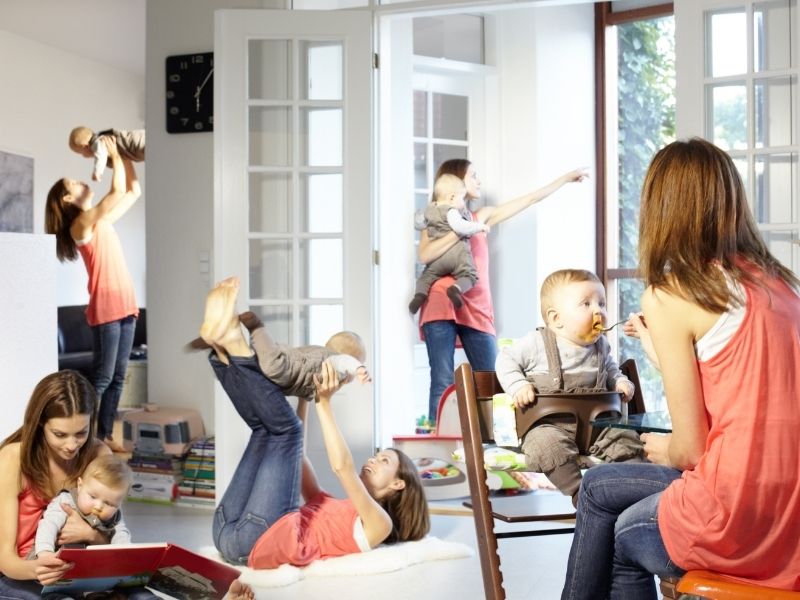
Put into market terms, a stay-at-home mother often performs the combined work of a full household staff. On average, a nanny or childcare provider in urban areas typically earns around ₱6,000 to ₱10,000 per month, a house helper handling cleaning and laundry earns about ₱6,000 to ₱8,000, a home cook can cost ₱8,000 to ₱12,000, and basic household financial management or administrative tasks—similar to a part-time personal assistant—can range from ₱8,000 to ₱15,000 monthly. These roles total roughly ₱28,000 to ₱45,000+ per month per household, a conservative estimate for the labor many women carry out daily without pay.
This has real economic consequences. Many women step away from formal employment to take on full-time caregiving roles, which keeps them statistically “inactive” in the labor force despite actively working every day. In 2018, the ILO stated that unpaid care and domestic work could account for as much as 9% of global GDP if assigned a monetary value. These numbers are proof that what happens inside the home does not mean it’s outside the economy; it is a major part of it, just not formally counted.
On the bright side, let’s not dwell only on statistics. Hats off to women with the bravery of a warrior and supportive men who saw flaws in the system, gender roles in more liberal cultures are slowly shifting. Still, many traditional female roles remain—not just out of habit, but because they continue to hold real function and value in everyday life.
Female Roles That Keep Households Running
The Role as Caregiver and Nurturer

Even though modern society is embracing equal capabilities between men and women more and more, women are still generally regarded as primary caregivers for children and the elderly in the family. This is because women are viewed as greatly empathetic and often demonstrate high emotional responsiveness and cognitive empathy, the ability to recognize emotions and take other perspectives.
Like mentioned, there are two layers to this: one being a product of social and cultural expectations, and the other being biological programming. Women’s hormones, particularly estrogen, can predispose females to higher levels of empathy and nurturing behavior. At a young age, girls are also often presented with toys that emphasize softer, more nurturing skills, which develop further as they grow up.
Over time, this combination has shaped expectations, placing emotional labor largely on women. In many households, this extends beyond physical care—-emotional support, conflict resolution, and maintaining relationships fall into this space as well, making caregiving a deeply layered and highly valued responsibility.
Management of the Household

Running a home has long been associated with women, though the nature of this responsibility has evolved. Today, household management goes beyond cooking and cleaning, and now includes budgeting, scheduling, organizing, and decision-making that keep daily life running smoothly.
In a household, money-making is typically considered the man’s responsibility, whereas women take on the role of “default manager,” where she handles invisible tasks such as tracking groceries, planning meals, remembering birthdays, or coordinating family schedules. These responsibilities need strict mental organization and foresight, which are frequently overlooked but truly important in maintaining structure at home.
Even in dual-income households, this mental load tends to remain uneven. However, awareness around shared responsibilities is growing, and more families are beginning to redistribute these roles in ways that feel balanced.
Passing Down of Culture
In the many roles that women take on as household managers, together with their empathetic, social abilities, they have also taken the role as custodians of culture—preserving and passing down years of belief and tradition within families and communities. This can be seen in food preparation, storytelling, language use, and other practices during gatherings and celebrations.
Recipes are not always just recipes; those handed down through generations carry personal histories. Family rituals, no matter how simple, are sustained through repetition and memory, frequently guided by women. This extends to teaching values, manners, and social behaviors, contributing to larger, more impactful matters that shape how younger generations understand identity and belonging.
Cultural continuity usually depends on these everyday actions. Through them, traditions remain alive, not as static practices, but as evolving expressions of heritage.

Community Building and Social Cohesion
Women are greatly participative in activities that build and maintain communities. This includes organizing events, supporting local initiatives, and creating networks that connect people with shared interests or needs.
One of Our Market’s partners, Queen of Hearts Couture Cakes by Valeri Valeriano and Christina Ong, is a close proof of this. Starting as curious young adults who barely knew anything about baking or buttercream, they took a leap of faith and went from selling small cupcake batches to conducting classes all over the world, publishing educational books, and even selling merchandise of their own. Eventually, they created Cake Club PH, a group of passionate bakers and food entrepreneurs, to build a welcoming community whose members help each other and have a great time together.

In both formal and informal settings, women often act as connectors. They bring people together as a way of initiating collaboration and sustaining group dynamics. This strengthens social cohesion and encourages collective participation, particularly in local environments.
These are just some of the things that make women an ever-important part of society. They are timeless contributors who create impact and put work into things often overlooked.
What’s a female role you still observe today? Share in the comments below!
For more reads on business, culture, food, and lifestyle, subscribe to Our Market.

