Cart is empty

MARKET WATCH
The truth about starting a burger business in 2026
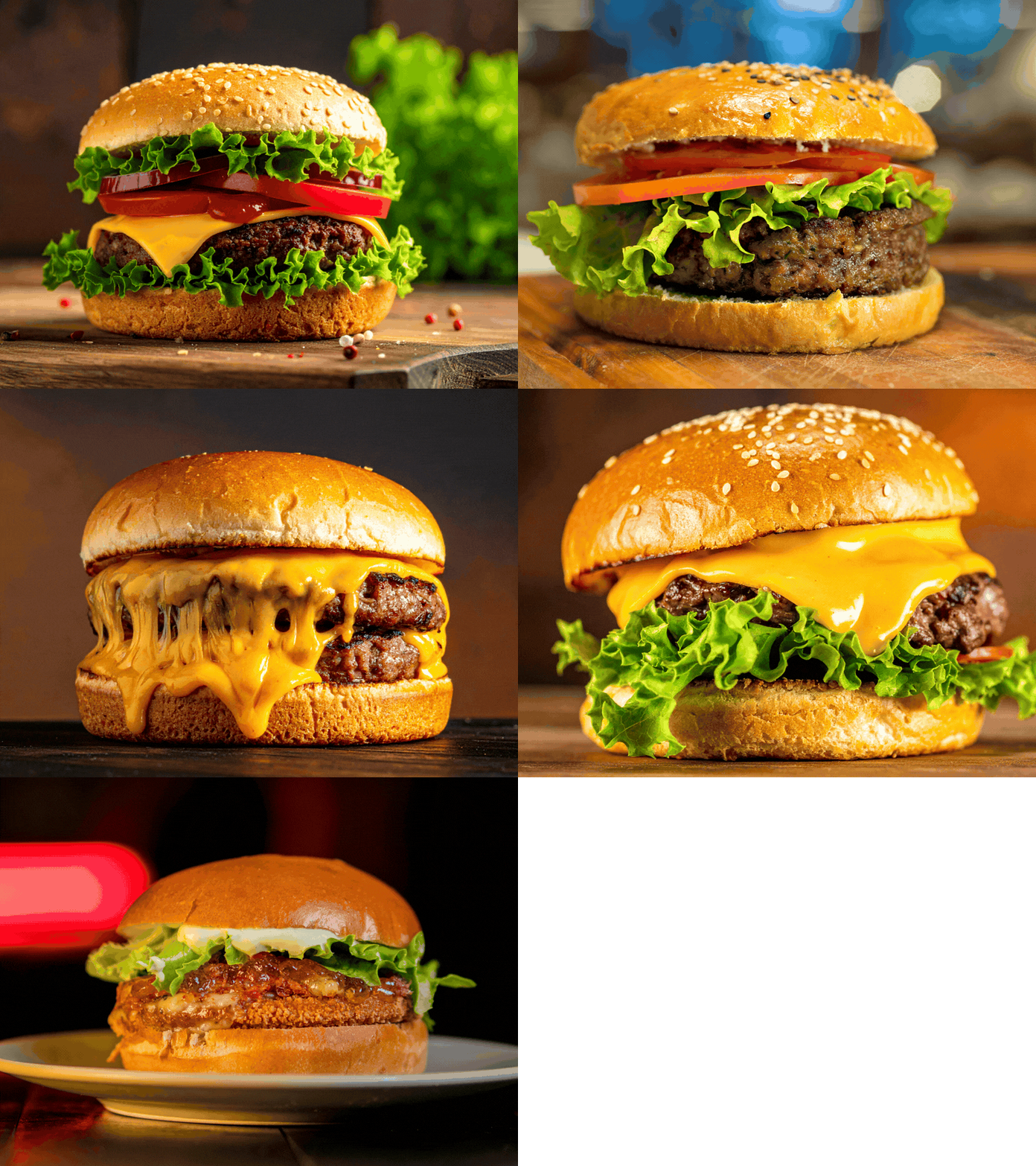
A burger business idea in 2026 is expected, as burgers are ingrained in Filipino food consumption to the same extremes as in foreign countries. This is already explicitly implied by the existence of all kinds of Filipino-owned burger restaurants: from kanto-style burgers, dominated by Angel’s Burger, Burger Machine, and Minute Burger, to mid-tier to premium burgers by Zark’s Burger, Brother’s Burger, 8 Cuts Burger Blends, Sweet Ecstasy, and Pound by English Todd.
Starting a burger shop in 2026 may stir hesitancy in some because of the competitive market today. Being this wary is wise, and while the competition is real, it does not mean shutting the idea completely down.
DATEMay 24, 2026
AUTHORANGELA CLARE AGPAWA
READ10 Min

Is it wise to build a burger business in the Philippines in 2026?
Unlike niche food concepts that require market education, burgers already have an established demand in schools, office districts, transport hubs, malls, food parks, and delivery applications.
This already reduces one major business risk: uncertainty in consumer behavior.
This means that the challenge is no longer convincing Filipinos to eat burgers. The challenge is competing inside a mature and crowded category. That distinction matters from an investment perspective because mature categories usually carry more predictable demand patterns than trend-driven food businesses.
Short answer: Yes. Building a burger business in the Philippines in 2026 is still wise. BUT, it can be risky. Having the right business model and learning how to counter risks is crucial.
It is not obvious-wise as in starting an online business in an era where every single thing takes place in the digital world, but in the sense that the food and beverage industry never dies, especially with a food item as fast as burgers.

Here’s why a burger business is both a yes and a but:
Delivery Compatibility
The continued expansion of the food delivery industry already puts a burger business at a high advantage.
2025 IMARC Group statistics show that the Philippine online food delivery market reached USD 4.8 billion and may reach USD 11.3 billion by 2034. Filipinos are increasingly eating inside cars, offices, dorms, condos, classrooms, and homes while juggling traffic, work schedules, and rising transportation costs.
Not to mention the increasing mobile usage, digital payments, and cloud kitchen businesses; the way the world moves as of the moment is built for convenience to be constantly sought after, which is effortlessly fulfilled by the delivery industry.
Looking at an operational perspective, burgers benefit well in delivery systems because they:
• travel relatively well
• require simpler packaging
• maintain structure better than heavily plated meals
• work best for cloud kitchens
These advantages take away a huge lot of operational pressure compared to restaurant concepts that are dependent on dine-in traffic and expensive physical spaces.

If you want to enter the market with lower capital requirements, while still offering something that even premium restaurants serve, burgers are the way to go. Instead of spending everything on interiors and rent, you can focus resources on branding, recipe development, marketing, and consistency first—which all food businesses do anyway. That means hitting two birds with one stone:
• Lower cost of physical space
• Taking advantage of fast food and delivery culture
This is the greatest strength of a burger business in 2026.
Pricing Segmentation
Burger businesses survive decades because burgers can exist at almost every price point imaginable.
Burgers outside school? Buy 1 Take 1 for ₱50.
Gourmet smash burgers inside lifestyle districts? Easy ₱500.
You can build delivery-only concepts targeting office workers. You can create premium burgers built entirely around aesthetics and social media marketing. Few food categories stretch across income groups this smoothly. It’s all up to you.
Sounds good. What’s the problem?
Not knowing the problem is the exact point where many businesses fail.
They set up the shop not knowing who they are actually selling to.
PwC consumer reports found that 45% of Filipino consumers actively prioritize budget brands, while 56% spend more carefully to maximize value. Consumers are becoming more price-sensitive, especially after years of inflation pressure affecting food, transportation, utilities, and daily expenses.
So before opening a burger business, answer this first:
Are you targeting mass-market volume, or those willing to spend more for experience, branding, ingredients, or presentation?
Beginner food businesses try to be iconic and do them all. When you do, you sit vaguely in the middle and end up being too expensive for budget buyers but not premium enough to justify higher pricing. As a result, you mostly attract one-time buyers.
Your pricing, serving size, store design, marketing style, and even your burger photography should match the exact market you are targeting.
Competitive Saturation
You cannot launch straight into the burger industry without understanding the market saturation. The good thing about market saturation is that it is neither inherently an advantage nor a disadvantage—it depends on perspective.
Burger franchises and kiosks already exist throughout urban areas in the Philippines. Because the market has low entry barriers, many businesses enter the category recklessly, forgetting to come up with strong differentiation.
But a business is mostly all about differentiation. Your burgers are no different from thousands of other burgers out there? Then why should people buy from you? You’ll only end up as another burger stall on the street.
This is how a business fails to survive market saturation.
However, saturation does not automatically indicate market decline. It usually equates to stable consumer demand alongside increased competitive pressure. The question is really not whether burgers are still selling; they obviously do. The question is: What makes your burger business distinguishable from others?
Any business without an identity tends to struggle long-term, especially in 2026.
Find a way to be different. Make healthy burgers, formulate your own signature sauce, follow trendy concepts—as long as you know how to be at least a little different, your burger business will grow slowly but surely.
Margin Pressure
Despite strong demand, burger businesses still face margin-related pressures.
Price increase in 2026 is no joke. Rising meat prices, delivery commissions, utilities, labor expenses, and rental costs continue to affect food entrepreneurs in the Philippines, especially with its long-standing financial crisis.

Market reports on the local delivery industry repeatedly mention operational sustainability as a growing challenge for small food businesses. (6Wresearch)
• This partly explains why many businesses aggressively pursue:
• Smaller serving sizes
• Simplified ingredients
• Combo promotions
• Value meals
• Limited-time products
Unfortunately, this strategy has stopped being purely about attracting customers. It has also become a means of preserving margins.
If you are constantly facing financial challenges or just have “enough” to start the business, the risk might be too much, realistically. Overnight success is rarer than most people like to romanticize.
Businesses entering the burger industry in 2026 therefore need stronger financial planning, especially when consumers expect affordability and quality simultaneously.
How to build a successful burger business
A good business background and meticulous planning are no-brainer requirements in starting a business. But at the end of the day, those should co-exist with high-quality products and services.
An important thing to know about purchasing behavior is that customers forgive simple menus, but they rarely forgive inconsistency.
No matter how small, an inconsistent preparation can immediately affect repeat purchases, especially now that consumers constantly post food online and compare brands publicly. This is why being more careful and intentional is important as a food entrepreneur.
Offer unique types of burgers to cater to different taste preferences and bring higher chances of sales. Good burger is not reliant on patty or buns alone, but in the combination of ingredients in between.
Attempting this could result in failure, and failure is not very advisable for startup businesses with limited capital—the only choice is to do it right.
Online workshops like The Bailiwick Academy’s Burger Obsession are made for this particular reason: to help businesses offer products that exceed standards. In this class are chicken burgers and smash burgers, two of the most popular burgers in the Philippines. It also includes longga burger made from longganisa patties, a Filipino-style burger that the masses would love.
Because this burger online course is business-centric, it also teaches concepts and insights that influence customer recall, beyond tested-and-proven burger recipes.
Read more business insights on Our Market.

