Cart is empty

MARKET WATCH
Food Preservation Business: Methods and How to Start
DATEJULY 26, 2026
AUTHORANGELA CLARE AGPAWA
READ5 Min
For micro, small, and medium enterprises (MSMEs), which make up 99.5% of all registered businesses in the Philippines, preservation techniques can open new opportunities. Seasonal produce can become year-round products, local ingredients can reach distant and even foreign markets, and homemade recipes can be made into commercially viable goods with longer shelf lives.
Here are five of the most common food preservation methods used by Philippine food businesses today.

Common Food Preservation Methods At Home
According to the 2020 Annual Survey of Philippine Business and Industry (ASPBI) by the Philippine Statistics Authority (PSA), the country's food manufacturing sector consistently ranks among the largest manufacturing industries in terms of value added and employment. At the same time, food loss remains a major concern. The Food and Agriculture Organization (FAO) estimates that around 13% of food produced globally is lost before reaching retail, while additional losses occur at the retail and consumer levels. Proper preservation helps businesses minimize these losses by extending the usability of raw materials and finished products..
Pickling
Pickling is an ideal food preservation method for startup food businesses due to its low level of difficulty. Using only a good fridge and some common ingredients found in the kitchen, you can pickle almost anything.
Ingredients needed for pickling include white vinegar, water, salt, and sugar. As for storage, any sealable glass mason jar will do.
Pickling food should be straightforward as long as you do not eyeball your ingredients like you would in other types of cooking. People tend to make common quick pickling mistakes such as adding more vinegar or sugar to preserve the food longer or alter the taste. It is also important not to assume perfection within just three days of pickling.
Filipinos are real lovers of pickles, but of course, with a local twist. Atchara and burong mangga are two of the most popular ones—being available at almost any restaurant in the country. Moreover, depending on the type of pickle, they can be paired with many different foods. Due to this, learning how to pickle to start a business can allow one to reach various markets.

Fermentation
It is common to ask the difference between pickling and fermentation. They might seem similar because both methods create a distinctly sour, tangy flavor profile and involve submerging food in a liquid (although dry salting exists too) and inhibiting the growth of harmful, spoilage-causing microorganisms. Common examples of fermentation include kimchi, sauerkraut, and lacto-fermented pickles.
But unlike pickling, which only takes minutes to a few days to achieve results, fermentation can take a few weeks up to a month due to a slow metabolic process of creating an environment where naturally occurring bacteria consume the natural sugars in food and convert them into lactic acid.
There are also two ways to conduct lacto-fermentation. The first one is by making a saltwater solution, which we call “brine” in this context, and submerging largely cut vegetable chunks in it. This is often the method for vegetables like cucumbers, thick-sliced carrots, or radishes.
The second one is dry salting, wherein you simply add salt to vegetables with high water content and let the salt drain the water by itself. This creates a natural brine and lets the vegetables soak in their own water.
While it takes longer to achieve the finished product, fermentation can be easily done at home by making a saltwater solution

Canning
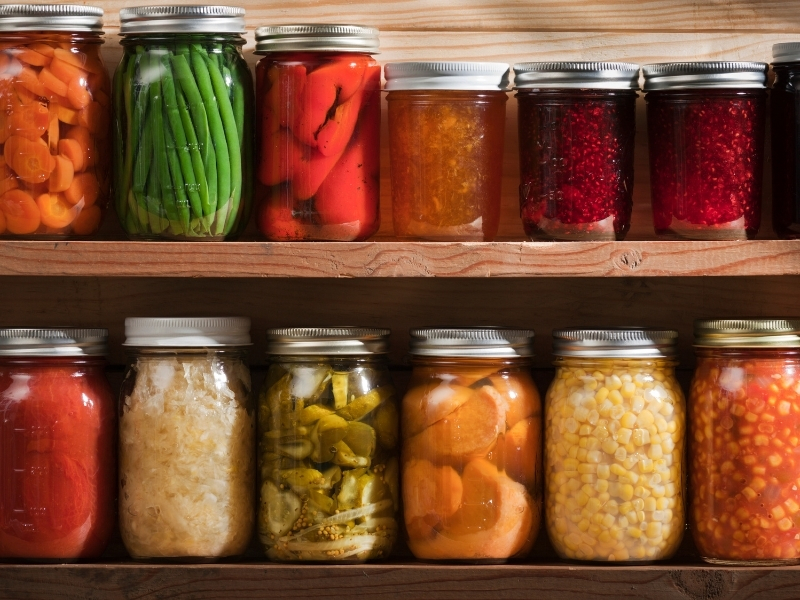
Canning is a highly effective food preservation method that seals cooked food in airtight jars, destroying spoilage-causing microorganisms and creating a vacuum seal.
Some examples we commonly consume include water bath-canned high-acid foods such as dill pickles, strawberry jams, and other sorts of jams, as well as pressure-canned meats like crab paste (bottled aligue), gourmet tuyo, and meat spreads.
Canning is a great homemade business idea because it is a less complicated and demanding way of selling your kitchen specialties. By canning, a great cook can start offering their products without heading straight to building a full-blown restaurant.

Sugaring
Sugaring works by drawing moisture out of food through osmosis, making it difficult for bacteria, yeast, and molds to grow. The high concentration of sugar lowers the amount of available water needed by microorganisms to survive.
This preservation method is commonly used for fruits, making fruit jams, jellies, marmalades, fruit preserves, candied fruits, and syrups. In the Philippines, more popular variants include local fruits such as mangoes, pineapples, calamansi, strawberries, and ube.
For small food businesses, sugaring is a great option to reduce spoilage during peak harvest seasons. Instead of selling fresh fruits that may only last a few days, they can be transformed into jams or preserves that remain marketable for several months when properly processed and packaged.
But remember, sugar alone does not guarantee food safety. Products still need proper cooking temperatures, sterilized containers, airtight packaging, and appropriate storage conditions. Businesses planning to sell commercially should also follow food labeling requirements and good manufacturing practices (GMP) established by Philippine regulatory agencies.

Dehydration
Dehydration is one of the oldest food preservation methods still widely used today. It removes moisture from food through sun drying, ovens, dehydrators, or industrial drying equipment. Since bacteria and molds require moisture to multiply, reducing water content significantly extends a product's shelf life.
A lot of Filipino food products use this process, such as dried mangoes, banana chips, dried fish, mushrooms, herbs, spices, and vegetable powders. Even coffee, powdered milk, instant noodles, and soup mixes involve dehydration during manufacturing.
For aspiring entrepreneurs, dehydration is a great option because it requires relatively few ingredients while preserving much of the food's original flavor and nutrients. Modern food dehydrators also provide more consistent results than traditional sun drying, which makes them suitable for small-scale commercial production.
One of the biggest advantages of dehydrated products is their lower weight; this reduces transportation costs and makes shipping to customers more affordable. However, proper moisture-proof packaging is equally important, as dehydrated foods can quickly absorb humidity from the surrounding environment.

How to start a packaged food business
Starting a packaged food business begins with learning safe food handling and food safety practices. While the concept of building a preserved food business sounds easy, the real struggle is scaling from a home kitchen to commercial production. Massive production of batches always comes with the risk of inconsistent quality and may even cause food poisoning in consumers.
It is important to look into food processing and food preservation classes to learn the proper way of creating preserved foods and sell them with the assurance that they are safe for consumption.
The Food Preservation Business Accelerator by The Bailiwick Academy is a 14-day business challenge for home cooks and aspiring entrepreneurs who want to launch a preserved food business.
The program will teach participants how to create five products: Papaya Atchara, Sauerkraut, Sweet & Spicy Green Mangoes, Pickled Shallots, and Tomato Ketchup , all with the guidance of veteran chef Chona Laureta, who has trained internationally and serves as an instructor at TESDA.
Moreover, it will guide you on how to turn it into an actual business through lessons on costing, branding, photography, packaging, and selling.

